



Key Takeaways
- Understand the timeline for DSCSA 2026 Compliance to avoid costly non-compliance penalties.
- Learn the essential components of the DSCSA Compliance Checklist for pharmaceutical manufacturers.
- Identify common gaps in serialization and traceability that may affect your operational compliance.
- Ensure your trading partners are verified and capable of electronic data exchange as per DSCSA requirements.
- Discover how Sun Teknovation Pvt Ltd can help you achieve and maintain DSCSA 2026 Compliance effectively.
Sun Teknovation Pvt Ltd is a Leading Provider of Track & Trace and Machine Vision Solutions for the Global Pharmaceutical Industry.
The Drug Supply Chain Security Act (DSCSA) has been in phased implementation since 2013. That phase is over. FDA enforcement is active, deadlines have passed for manufacturers and distributors, and the consequences of non-compliance are no longer theoretical. They are showing up as rejected returns, failed audits, and FDA warning letters.
If you are a pharma manufacturer supplying the US market and you are still treating DSCSA 2026 Compliance as something to address later, the risk is already on your loading dock. This checklist is designed to help you identify exactly where your operation stands — and what needs to be fixed.
Where DSCSA Enforcement Currently Stands
The DSCSA rollout followed a clear timeline, and it is now in its final phase:
- Manufacturers — enforcement crossed the May 27, 2025, deadline
- Wholesale Distributors — enforcement active from August 27, 2025
- Large Dispensers (26+ staff) — enforcement from November 27, 2025
- Small Dispensers (25 or fewer) — final deadline November 27, 2026
For pharma manufacturers, this is not a 2026 concern — it is a 2025 reality that is already affecting supply chain relationships. DSCSA Enforcement Pharma Manufacturers means every serialized unit you ship must carry verified traceability data that your trading partners can receive, validate, and act on electronically.
The DSCSA Compliance Checklist
Use this Drug Supply Chain Security Act Checklist to audit your current setup against what full enforcement actually requires:
1. Unit-Level Serialization
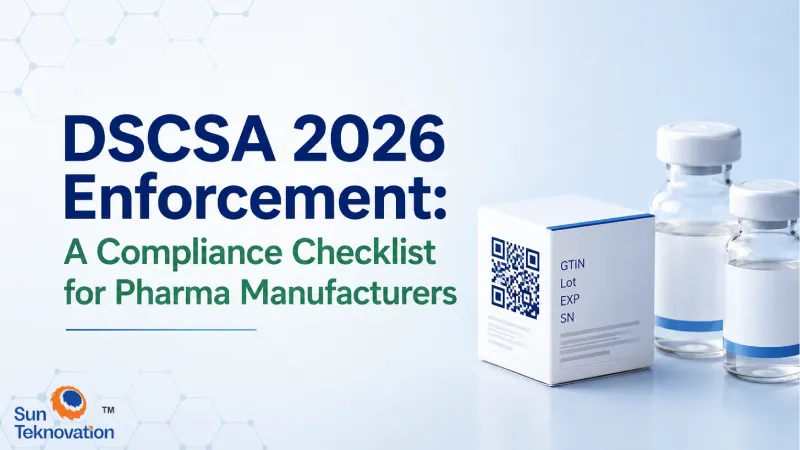
Every saleable unit must carry a unique product identifier (PI) as a 2D Data Matrix barcode encoding the GTIN, serial number, lot number, and expiration date. This is the baseline of Pharma Serialization DSCSA 2026 — without it, nothing else in the compliance stack works.
2. EPCIS-Based Electronic Data Exchange
DSCSA requires electronic, interoperable traceability using the GS1 EPCIS (Electronic Product Code Information Services) standard. Transaction Information (TI), Transaction History (TH), and Transaction Statements (TS) must be exchanged with trading partners in this format — not PDFs, not spreadsheets.
3. Verified Trading Partner Connectivity
Every entity you transact with must be an Authorized Trading Partner (ATP). Your system must verify ATP status before exchanging product and traceability data. If a trading partner cannot receive or send EPCIS-formatted data, that connection is a compliance gap — for both parties.
4. Saleable Returns Verification
One of the most operationally impactful DSCSA Compliance Requirements is the obligation to verify saleable returns before they re-enter your inventory. A return that cannot be matched to its original transaction data cannot be restocked. Distributors are already enforcing this, and manufacturers must have a process to handle these verification requests at scale.
5. Product Verification and Investigation Capability
When a suspect or illegitimate product alert is raised — either through the FDA's verification system or from a trading partner — your organization must be able to investigate and respond within defined timeframes. This requires a serialization system with full query capability, not just data storage.
6. Exception Management Process
Exceptions happen — mismatched data, scanning failures, damaged codes. DSCSA Enforcement Pharma Manufacturers requires documented, electronic exception management processes. An undocumented exception is indistinguishable from a deliberate compliance failure during an audit.
7. Master Data Accuracy
GTINs, NDCs, GLNs (Global Location Numbers), and product hierarchies must be clean, current, and harmonized across your systems before any of the above works. Master data errors are the most common root cause of EPCIS transmission failures — and they are entirely preventable.
8. System Validation and Audit Trail
Your serialization and traceability system must meet 21 CFR Part 11 data integrity standards — tamper-evident electronic records, complete audit trails, and validated software. An unvalidated system change is a compliance finding regardless of whether the physical serialization is correct.
What Gaps Look Like in Practice
A manufacturer can pass every internal quality check and still have active DSCSA 2026 Compliance gaps. The most common real-world failures are:
- Serialization data that is generated but never transmitted to trading partners in EPCIS format
- Returns verification processes that rely on manual lookups rather than system-level queries
- Trading partner connections that have never been tested with real production data
- Exception events that are handled operationally but never documented electronically
These are not theoretical risks. Trading partners are already encountering them, and the friction they cause — rejected returns, delayed shipments, disputed receipts — is measurable and growing as Pharma Serialization DSCSA 2026 enforcement tightens across the supply chain.
How Sun Teknovation Pvt Ltd Supports DSCSA Compliance
Sun Teknovation Pvt Ltd. track and trace platform addresses the full Drug Supply Chain Security Act Checklist — from inline serialization and aggregation to validated electronic records and traceability reporting. Our systems handle GS1-compliant 2D Data Matrix encoding, multi-level aggregation, and electronic data generation in formats compatible with trading partner exchange requirements.
With 14+ years of engineering experience, 1,250+ global installations, and active deployments across DSCSA, EU FMD, BPOM, and ANVISA markets, Sun Teknovation Pvt Ltd brings direct implementation knowledge — not just product specifications — to every compliance project.
Why Choose Us
At Sun Teknovation Pvt Ltd., we build serialization and track and trace systems specifically for the demands of regulated pharmaceutical manufacturing — not generic industrial solutions adapted for pharma. Our platform covers the complete DSCSA Compliance Requirements stack: unit-level serialization, aggregation, validated electronic records, and the data integrity standards that FDA audits check. With deployments across 60+ countries and a team that understands what DSCSA Enforcement Pharma Manufacturers actually looks like during an inspection, we support your facility from implementation through validation and beyond — so your compliance is real, not just documented. When trading partners and regulators check, your operation will hold up.
Conclusion
DSCSA enforcement is not coming — it is here. Manufacturers crossed their compliance deadline in May 2025, and every shipment made since then carries DSCSA 2026 Compliance obligations. The Drug Supply Chain Security Act Checklist above covers the eight areas where most manufacturers have real gaps — serialization, EPCIS exchange, trading partner verification, saleable returns, exception management, master data, system validation, and product investigation capability.Closing these gaps is not a long-term project. Many can be addressed with the right serialization system and implementation partner. Sun Teknovation Pvt Ltd is ready to help you work through this checklist, identify your specific gaps, and get your operation to a standard that holds up under both trading partner scrutiny and FDA inspection.Are there any gaps in your serialization and traceability configuration that you haven’t yet discovered, or does it satisfy every need on the DSCSA checklist? Connect with Sun Teknovation Pvt Ltd today and get your compliance posture assessed before your next trading partner or FDA audit does it for you.
Call us: +91 98982 45695 or Email: connect@sunteknovation.com.
Frequently Asked Questions

Ajay Roshania
Co-Founder & Director (Technical), Sun Teknovation Pvt. Ltd.
Visionary leader driving India’s pharma innovation globally. Expert in turning regulatory challenges into growth opportunities. Leads development of intelligent, future-ready systems that ensure compliance, trust, and scalability. Champion of “Made in India, Trusted Everywhere,” preparing the pharma industry for long-term success.