



Key Takeaways
- L3 acts as the control tower for your plant, managing serialization data efficiently.
- Choosing between L3 and L4 hinges on your operational scale and export market needs.
- Selecting the right Track and Trace System in India can save costs and enhance compliance.
- L4 centralizes reporting across multiple sites and adapts to varying international requirements.
- Vendor support is vital; choose one that ensures system longevity and compliance updates.
If you are evaluating serialization for your plant, L3 and L4 will come up in the first meeting. The terms get used loosely, and the difference between them is often blurred by vendors describing whatever they happen to sell.
The cost of getting it wrong runs both ways. Specify too high and you pay for enterprise capability a single-site operation will never touch. Specify too low and you hit a wall the first time a new export market asks for data your system was never built to send.
The Five-Level Serialization Model
Serialization is normally described as a stack, each level sitting on the one below it:
- L1 — Device level: printers, cameras and marking systems that apply and read codes on the line
- L2 — Line level: controls a single packaging line, manages devices, handles rejects and aggregation events
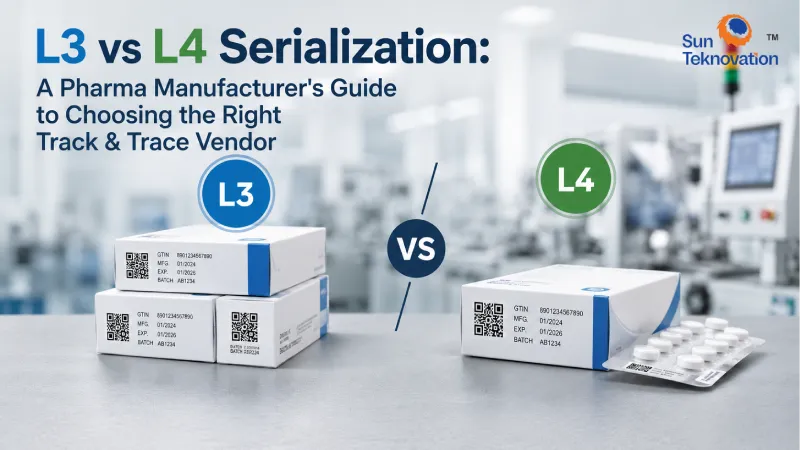
- L3 — Site level: oversees all lines within one plant, manages batches, and holds serialization data for the facility
- L4 — Enterprise level: connects every site across the company and exchanges data with external parties
- L5 — External level: the systems your L4 talks to, outside your organisation
A note on L5
L5 is frequently described as "the government system." That is only sometimes accurate.
Depending on the country and the trading relationship, L5 represents a national repository, an external enterprise system belonging to a partner, or a verification network. A distributor's platform and a national reporting portal both sit at L5, and they behave very differently. Treating the level as a single government endpoint leads to scope decisions that do not survive the first export market.
What L3 Actually Does
L3 is the plant's control tower. It sits above your packaging lines and manages everything happening inside one physical site.
It assigns and reconciles serial numbers, tracks batch status, receives Track and Trace Aggregation data from the lines, and holds an audit trail of what was produced, rejected or reworked.
For a manufacturer running one or two facilities selling mainly into the domestic market, a well-configured L3 is often the practical answer. It covers site-level reporting and keeps the data organised without the cost and integration effort of an enterprise layer. A solid Track and Trace System in India at L3 gives you full visibility of the plant floor and records that stand up in an audit.
What L4 Adds On Top
L4 sits above your L3 sites and acts as the single point of contact between your company and everything outside it.
You genuinely need L4 when:
- You run multiple manufacturing sites and want one consolidated data view
- You export to several countries, each with its own reporting format and endpoint
- You exchange serial data with CMOs or contract packers running their own systems
- You need corporate-level reporting drawing from every plant at once
L4 also absorbs a problem most people underestimate. Reporting requirements are country dependent, and they do not align. Some markets receive aggregation data. Others operate at unit level only and will not accept it at all. Some require event reporting at dispatch, others at commissioning.
Handling that variation plant by plant is where serialization projects quietly turn expensive. L4 centralises it, which is why exporters tend to work with Track and Trace System Manufacturers in India who can deliver both layers as one connected system rather than two products stitched together after the fact.
How to Actually Decide
The common mistake is treating this as a bigger-is-better decision. It is not. It is a matching exercise.
Three questions settle it for most manufacturers:
- How many sites do you run? A single plant rarely justifies a full L4 layer on day one.
- How many export markets do you serve? Every additional country with its own reporting requirement pushes you toward L4.
- How fast are you growing? If new sites or markets are realistic within two years, building on a platform that scales to L4 avoids a migration you will not enjoy.
The sensible position for most growing manufacturers is choosing a vendor whose L3 and L4 are designed to work together. That lets you commission L3 now and activate L4 when the business actually requires it, without replacing your Track and Trace in India setup and revalidating from scratch.
Choosing the Vendor, Not Just the Level
The level matters. The partner matters more.
Serialization is not a one-time installation. It is a system your production depends on every day for years, and a vendor who goes quiet after go-live can cost you a shipment, a market, or a clean audit report.
When you evaluate Track and Trace System Manufacturers in India, look past the demo:
- How do they handle line integration during installation and line setup, and who owns the schedule?
- What is the actual response path when a line stops at 2 am?
- How do they keep software current as country requirements change?
- Does their Track and Trace Aggregation hold read accuracy at your real production speed, not a lab figure?
- What does the audit trail look like, and will it satisfy the format your quality team has to present?
The stronger Track and Trace in India providers combine dependable hardware, flexible software and a support team that stays engaged well after commissioning.
Why Choose Us
Sun Teknovation Pvt Ltd., builds serialization systems that grow with the business instead of boxing it in. Our platforms are designed so you can commission at L3 and expand to L4 as sites and export markets increase, without heavy rework or a second major investment. We bring machine vision expertise, clean line integration and reliable aggregation to every project, and we stay involved long past go-live. Our team understands the daily pressure of a pharma packaging line, so read accuracy, fast support and audit-ready data are where our attention goes. We are also direct about what a level will not do for you, which usually saves more money than the quotation does.
Conclusion
Choosing between L3 and L4 is not about selecting the larger option. It is about matching serialization capability to how your operation runs today and where it is genuinely heading. A single-site domestic manufacturer runs well on a solid L3. A multi-site exporter needs L4 to manage country-specific reporting without every plant solving it independently. The decision that ages best is a vendor whose levels connect properly, so you scale on your own timeline rather than theirs.
Not sure whether L3 or L4 fits your operation? Talk to Sun Teknovation for practical, honest guidance. Call +91 98982 45695 or email connect@sunteknovation.com to plan your track & trace setup.
Frequently Asked Questions

Ajay Roshania
Co-Founder & Director (Technical), Sun Teknovation Pvt. Ltd.
Visionary leader driving India’s pharma innovation globally. Expert in turning regulatory challenges into growth opportunities. Leads development of intelligent, future-ready systems that ensure compliance, trust, and scalability. Champion of “Made in India, Trusted Everywhere,” preparing the pharma industry for long-term success.