



Key Takeaways
- NAFDAC's traceability regulations are now law, effective January 2027, impacting pharmaceutical exports to Nigeria.
- Exporters must implement Track and Trace in India to comply with GS1 regulations for marketing authorisations.
- All pharmaceutical products must feature a GS1-compliant Data Matrix, including GTIN and unique serial numbers.
- Global Location Numbers (GLN) and event reporting to NTIS are crucial for compliance and traceability success.
- Aggregation is essential to track shipments accurately; it links units to shipping cases and pallets.
Sun Teknovation is a leading manufacturer of serialization, aggregation and track and trace systems for pharmaceutical packaging lines.
Nigeria is one of the largest destinations for Indian pharmaceutical exports, and the rules governing that trade have changed in a way many exporters have not fully priced in. NAFDAC's traceability regulations are no longer a draft or a pilot. They are gazetted law, and from January 2027 compliance becomes a condition for holding a marketing authorisation at all. If your product is not compliant, the question is not about a penalty. It is about whether your registration gets renewed.
What the Regulation Actually Says
The Pharmaceutical Products (Traceability) Regulations, 2024 were gazetted on 30 October 2024 and have been in full legal force since. In a circular issued in 2026, NAFDAC confirmed that enforcement begins on 1 January 2027 and that compliance will be a compulsory condition for both new marketing authorisations and renewals of existing ones.
The regulation binds a wide set of stakeholders — marketing authorisation holders, manufacturers, importers, local representatives, distributors, wholesalers, hospital and community pharmacies, procurement agencies and healthcare facilities.
The Enforcement Timeline
NAFDAC has set a phased schedule, and each phase closes a category permanently:
- 1 January 2027 — narcotics and controlled substances
- 1 January 2028 — MNCH commodities, antibiotics and antimalarials
- 1 January 2029 — all finished pharmaceutical products
Implementation has already been running in stages since 2024, starting with narcotics and controlled substances, followed by MNCH products, antibiotics and antimalarials in 2025. So, the 2027 date is an enforcement point, not a starting point.
For Indian exporters, the practical reading is simple. If you supply antibiotics or antimalarials into Nigeria, your line has to be ready well before January 2028, and any project involving Track and Trace in India for that market needs to begin now rather than in the final quarter.
What Must Be on the Pack
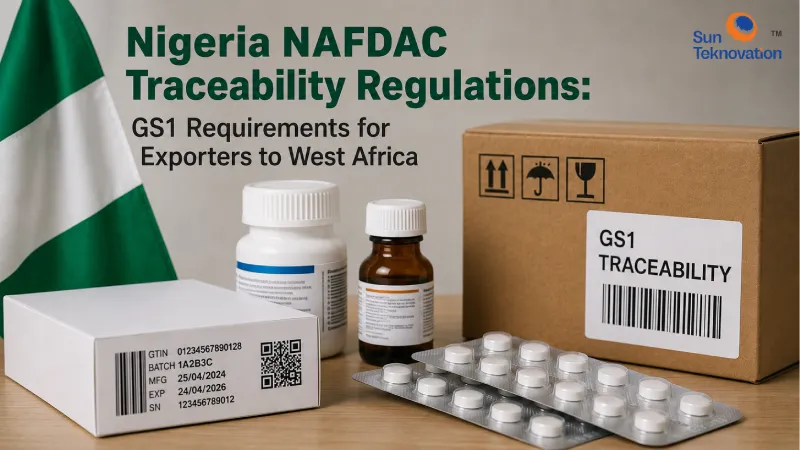
Every pharmaceutical product must carry a GS1-compliant two-dimensional Data Matrix containing:
- GTIN — Global Trade Item Number
- Batch or lot number
- Expiry date
- Serial number
These sit under Regulations 5 and 6. A serial number that is unique against the GTIN is the core of it — a batch code alone does not satisfy the requirement, which is where several exporters still get flagged.
Any Track and Trace System in India you deploy for this market must generate serials in GS1 format, print them reliably at your line speed, and read each code back before the pack moves on. Printed but unverified is treated the same as absent once the code fails to scan downstream.
GLN and NTIS: The Part Most Exporters Miss
Two requirements go beyond the pack itself, and these are where projects usually run late.
Global Location Number. Every facility involved in manufacturing, distribution or dispensing must obtain and maintain a valid GLN, with responsibility resting on the facility owner under Regulation 11.
Event reporting to NTIS. Regulated entities must transmit traceability event data — commissioning, shipping, receiving, dispensing and other prescribed supply chain events — to the NAFDAC Traceability Information System under Regulation 12.
NAFDAC has advised regulated entities to work with a NAFDAC-approved, GS1-accredited traceability solution provider for serialisation, GLN acquisition and NTIS integration. Dispensing points can use the free NAFDAC Scan2Verify mobile application for verification and dispensing-level reporting.
Why Aggregation Decides Whether You Can Report
Shipping and receiving events describe cases and pallets, not individual packs. Without a recorded parent-child hierarchy, there is no way to report what left your facility.
This is where Track and Trace Aggregation stops being optional. Aggregation links each unit to its carton, each carton to its case, and each case to the pallet, normally identified by an SSCC under GS1 standards. When a case is scanned at dispatch, the system already knows every serial inside it.
Lines that serialise without aggregating end up reconstructing hierarchies manually before every shipment. That works for a few consignments and collapses at volume. Any serious Track and Trace Aggregation setup should commission the parent-child link on the line itself, flag mismatched or missing children at the station where the fault occurred and hold a timestamped record of what was read and when.
Four Questions to Ask Before You Commit
- Does the system output serials and event data in GS1 format ready for NTIS integration?
- How is Track and Trace Aggregation handled — on-line commissioning or manual assembly afterwards?
- What is the sustained read rate on our actual pack format and line speed?
- How are rejects and re-aggregation recorded in the audit trail?
Teams evaluating Track and Trace System Manufacturers in India should put these four on the table in the first meeting, along with their own pack formats and destination market list.
Why Choose Us
Sun Teknovation Pvt Ltd., builds machine vision hardware and serialization software in-house, and that single-owner structure is what keeps a project moving when something needs attention on the line. Our platform handles GS1 Data Matrix generation and verification, OCR and OCV inspection, and multi-level aggregation from unit through to pallet, with export-oriented manufacturers in mind — our systems run in over 60 countries, so multi-market packaging requirements are familiar ground for us. Our engineers work alongside your team through integration, tune camera positions and lighting to your actual pack format rather than a demo carton, and stay reachable after commissioning. We are equally direct about what a format cannot support, because a specification agreed honestly at the start costs far less than rework after a regulatory deadline has passed.
Conclusion
Nigeria's traceability framework is settled law with fixed enforcement dates, and market access now depends on it. The work involves four connected pieces: GS1 Data Matrix coding with a unique serial, verification on the line, aggregation through every packaging level, and event reporting into NTIS from GLN-registered facilities. Miss any one and the others cannot carry the requirement alone. Exporters who treat this as a packaging line project rather than a documentation exercise will keep their registrations moving. Those who wait for the deadline will be competing for engineering time with everyone else in the same position.
Exporting to Nigeria or wider West Africa and planning your serialization and aggregation setup? Talk to Sun Teknovation about the right system for your pack formats. Call +91 98982 45695 or email connect@sunteknovation.com .
Frequently Asked Questions
NAFDAC Nigeria traceability GS1 standards pharma serialization track and trace aggregation system West Africa exports drug traceability NTIS reporting pharma compliance