


Key Takeaways
- Schedule H2 now mandates QR codes for all vaccines, antimicrobials, anticancer, and NDPS drugs.
- Compliance dates for these categories start from July 2027 and July 2028.
- A reliable QR Code Inspection Machine in India ensures codes meet ISO/IEC 15415 grading standards.
- Proper verification systems are crucial for confirming readability and maintaining quality control in packaging lines.
- Schedule H2 now mandates QR codes for all vaccines, anti-cancer drugs, and NDPS substances starting July 2027.
Sun Teknovation is a leading manufacturer of barcode, pharma code and OCR code inspection systems for pharmaceutical packaging lines.
For three years, the QR code mandate under Schedule H2 applied to a defined list — the top 300 pharmaceutical brands. If your product was not on that list, the requirement did not touch your line. That boundary has now gone for four entire therapeutic categories, and the volume of SKUs coming into scope is far larger than most packaging teams have budgeted for.
What Changed on 22 June 2026
The Ministry of Health and Family Welfare notified G.S.R. 506(E), the Drugs (Seventh Amendment) Rules, 2026, amending the Drugs Rules, 1945. The amendment brings four full categories under Schedule H2 rather than a brand list.
Categories now covered:
- All vaccines
- All antimicrobials
- Every substance classified as a narcotic or psychotropic under the NDPS Act of 1985
- All anti-cancer drugs
Compliance dates:
- 1 July 2027 — vaccines, anti-cancer medicines, and NDPS narcotics and psychotropics
- 1 July 2028 — antimicrobials
The staggered dates are not a concession. Antimicrobials are the largest and most fragmented category, which is why they were given the extra year.
What the Code Must Carry
Manufacturers must print or affix a barcode or QR code on the primary packaging label. Where there is inadequate space on the primary pack, it may be placed on the secondary packaging label.
The code must store data accessible through software applications, covering:
- Unique product identification code
- Generic name of the drug
- Brand name
- Name and address of the manufacturer
- Batch number
- Date of manufacturing and date of expiry
- Manufacturing licence number
- Details of excipients, where applicable
Where Most Packaging Lines Will Fall Short
Printing a code is the easy part. The problem shows up at verification.
Even a QR code appears flawless to the human eye, it may not meet the ISO/IEC 15415 grade criteria, which is necessary for automatic reading. Once a code is degraded past that point, nothing downstream repairs it — the pack is either rejected at the next station or reaches the market unreadable.
Common failure points on live lines include:
- Codes printed correctly but never read back and confirmed before the pack leaves the station
- Print quality drifting through a shift as the print head heats or substrate varies
- Glare or curvature on vial and ampoule labels defeating the read at line speed
- Small primary packs where a code compressed into limited space loses grade
- An audit trail gap results from manual rejects that are handled without a record.
This is exactly why a Code Verification System sits at the centre of Schedule H2 readiness, not the printer. A printer commits ink. Only verification confirms that what was committed can actually be read.
What a Reliable Code Verification System Provides
Each pack is read after printing, graded against the standard, and either passed or rejected before it moves on. When Product Code Verification is set up correctly, it provides:
- Grade-based pass and fail decisions, not a simple read-or-no-read check
- At the station where the issue occurred, unreadable, duplicate, or missing codes were reported.
- Rejects contained at the point of discovery rather than at dispatch
- A timestamped audit trail recording what was read, when, and what the system decided
That last point is what quality teams and auditors actually ask for. They rarely ask whether you own a Qr Code Inspection Machine in India — they ask you to produce the record showing it was running and grading valid codes for the batch under review.
Primary Pack Reading Is the Harder Job
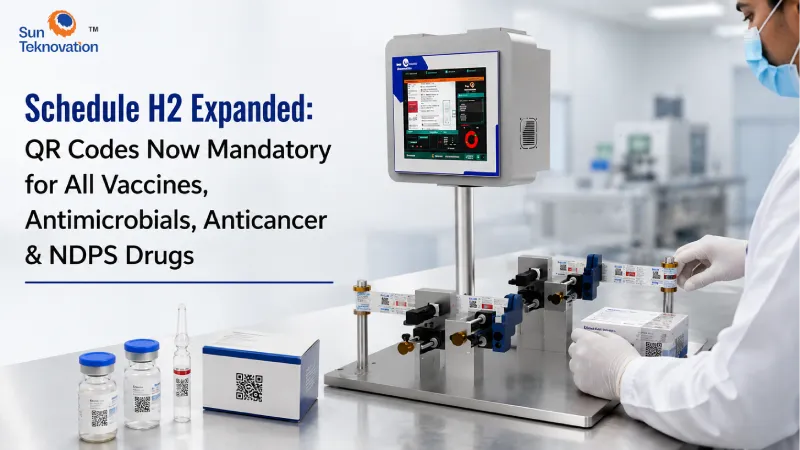
Vaccines, oncology products and NDPS formulations sit heavily in vials, ampoules and small cartons. Reading a code on a curved, reflective, small-format primary pack is a different engineering problem from reading a flat carton, and it is where a general-purpose Barcode Inspection System in India often disappoints at real line speed.
Lighting geometry, lens selection and camera positioning decide the outcome here more than software features do. Any Code Verification System you evaluate should be demonstrated on your own pack format before the order is placed.
Before You Commit to a Machine
Four questions are worth putting to any supplier:
- What is the sustained read rate on our actual pack format and line speed, not a laboratory figure?
- Does the system grade codes to ISO/IEC 15415, or only confirm a successful read?
- How are rejects handled and recorded, and can the correction be traced?
- Does the audit trail format match what our quality team will be asked to present?
A Product Code Verification system quoted without your pack format attached tells you very little. Teams planning to buy a Qr Code Inspection Machine in India should have both on the table from the first conversation.
Why Choose Us
Sun Teknovation Pvt Ltd., brings machine vision engineering together with hands-on experience of pharmaceutical packaging lines, and that combination shapes how our systems are built. We design for the speeds lines actually run at, without trading away read accuracy, and our barcode, pharma code and OCR reading platform is built around grading and verification rather than a simple read confirmation. Our engineers work alongside your team through integration, tune the system to your pack formats and code positions, and stay reachable long after commissioning. We are equally direct about what a system will not do — whether a format needs rework or a mark simply does not consume the data you were planning to generate.
Conclusion
Schedule H2 has moved from a brand list to whole therapeutic categories, and the dates are fixed. Antimicrobials are covered in July 2028; vaccines, anticancer, and NDPS medicines are covered in July 2027. The work ahead is not simply adding a printer. It is proving that every code leaving your line is readable, correctly graded and recorded, across primary packs that are far harder to read than flat cartons. Lines that treat verification as the core of the project will be ready. Lines that treat it as an accessory to printing will hold data that looks compliant but answers nothing when an auditor asks.
Planning Schedule H2 readiness for your vaccine, oncology, NDPS or antimicrobial packaging lines? Talk to Sun Teknovation about the right inspection setup for your pack format. Call +91 98982 45695 or email connect@sunteknovation.com .
Frequently Asked Questions
Schedule H2 QR code mandate drug traceability code verification barcode inspection pharma packaging anticancer drugs antimicrobial resistance NDPS drugs CDSCO compliance