



Key Takeaways
- Serialization creates unique identifiers for each unit but does not establish relationships between packaging levels.
- Aggregation establishes a parent-child chain from unit to pallet, vital for effective track and trace aggregation.
- Many packaging lines fail at the execution stage, often at the packing station—not in the software.
- A reliable aggregation system flags errors at the packing level, preventing issues from escalating downstream.
- Ensure your aggregation system integrates well with existing software for effective traceability and audit trails.
If your packaging line is serialized, half the job is done — every saleable unit carries an identity. Yet in our conversations with pharmaceutical manufacturers across India and export markets, the same gap keeps appearing: the serialization software is running, but the packing hierarchy linking unit to carton to case to pallet is either incomplete or never reaches the system that will be asked for it later.
What Serialization Establishes
Serialization creates a unique serial number for each saleable unit and associates it with the product GTIN, batch number and expiry date within the GS1 Data Matrix.
Four data elements sit inside that symbol:
- GTIN under Application Identifier (01), 14 digits
- Serial number under (21), unique to each saleable unit
- Batch or lot number under (10)
- Expiry date under (17), in YYMMDD format
What serialization does not establish is position. A serial number tells you what a pack is, not which shipper it travelled in.
What Aggregation Establishes
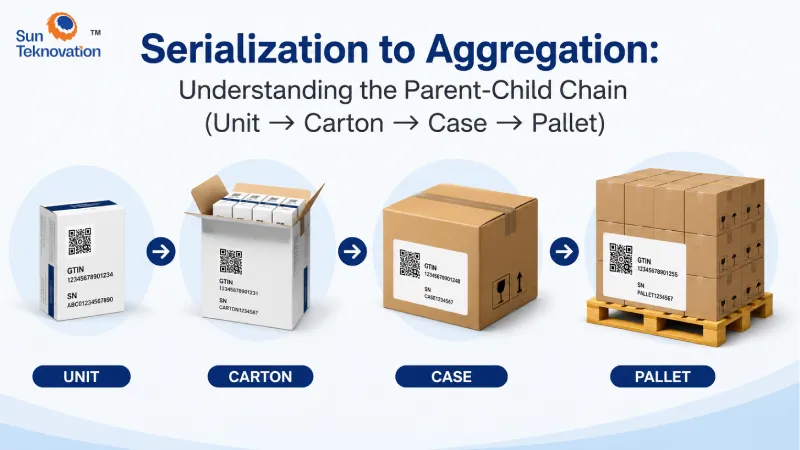
Aggregation records the physical packing structure as a digital parent-child relationship, where each level becomes the parent of the level beneath it:
- Unit — the individual serialized pack, child of the carton
- Carton or bundle — child of the case, parent of its units
- Case or shipper — child of the pallet, parent of its cartons
- Pallet — top-level parent, normally identified by an SSCC under AI (00)
The condition that gets skipped
One scan retrieves the aggregation hierarchy only if that hierarchy has been successfully commissioned on the line and uploaded into the system being queried.
If the events were never generated, were rejected at commissioning, or were never transmitted, the pallet code returns nothing. The label is there. The relationship behind it is not. This is the working basis of Track and Trace Aggregation, and the reason a Packaging Aggregation Machine should be judged on what it commits, not only on how fast it reads.
Where Most Packaging Lines Fall Short
The theory is clear. The gap is in execution, and it usually sits at the packing station rather than in the software.
A Data Matrix can look clean to the eye and still fall below the ISO/IEC 15415 grade threshold that automated reading depends on. Codes degraded beyond ISO grade limits cannot be read reliably by any vision system, and nothing downstream repairs a symbol printed badly upstream.
Common failure points include:
- Aggregation events generated on the line but never confirmed as uploaded to the L4 platform
- Re-aggregation after a reject handled manually, breaking the parent-child link without a record
- A case sealed with a short count, leaving a parent holding the wrong children
- Pallets built correctly, but the SSCC never associated with the case codes beneath it
- Read stations positioned where glare or packaging partially obscures the code at line speed
What a Reliable Packaging Aggregation Machine Provides
Units are read as they enter the carton, their serials are associated with the carton code, and that relationship is committed as an aggregation event. The same logic repeats upward until the pallet identifier carries the full structure.
A correctly implemented system delivers:
- Mismatched, duplicated or missing units flagged at the station where the error occurred
- Aggregation events structured so your L4 platform or EPCIS layer can consume them
- Rework contained at packing level instead of discovered at dispatch
- A timestamped audit trail recording what was read, when, and what the system decided
That last point is what auditors and customers actually ask for. They rarely ask whether you own an aggregation system — they ask you to produce the audit trail showing it was running and generating valid records for the batch under review.
A Multi 2D Aggregation Machine in India reads several codes within one field of view rather than presenting packs sequentially. Whether that produces a throughput gain depends entirely on the machine design, the packaging format and where the station sits in your layout. That answer comes from studying the line, not from a datasheet.
Pallet Aggregation and Market Requirements
Pallet Aggregation closes the loop — one scan to receive or dispatch, and during a recall the affected units come out of the recorded hierarchy rather than despatch paperwork. Verified while the pallet is built, it also flags a case that does not belong to that consignment before it leaves the facility.
Aggregation is not a single global mandate, and this is where published guidance often overstates the position:
- Some countries require aggregation data reported into a national system
- Others require unit-level serialization only, and their repositories do not receive aggregation data
- In several markets it is commercial rather than regulatory, driven by distributors who will not accept stock without it
Your machine specification follows your destination market list, not the reverse. Confirm the current position for each market with that country's regulator or a qualified regulatory affairs professional before the line scope is frozen.
Before You Commit to a Machine
One broken parent-child link can hold a full consignment, which is why the choice among Multi 2D Aggregation Machine Manufacturers in India shapes the whole line rather than one station.
Before installation and line setup, these are the points worth putting to any supplier:
- What is the sustained read rate at our actual line speed, not a laboratory figure?
- How are rejects and re-aggregation handled, and is the correction recorded?
- How does the system integrate with our existing serialization and L4 layers?
- Does the audit trail format match what our quality team will be asked to present?
A read rate quoted without your packaging format attached tells you very little, and teams planning to Buy Multi 2D Aggregation Machine in India should have both on the table from the first conversation.
Why Choose Us
Sun Teknovation Pvt Ltd., brings machine vision engineering together with practical experience of pharmaceutical packaging lines, and that combination shapes how our systems are built. We design for the speeds lines actually run at, without trading away read accuracy. Our engineers work alongside your team through integration, tune the system to your packaging formats and code positions, and stay reachable long after commissioning. We are equally straightforward about what a system will not do, whether a format needs rework or a market simply does not consume the data you were planning to generate.
Conclusion
Aggregation is what turns a set of individual codes into a supply chain you can question. Link every unit, carton, case and pallet into one verified chain, commission it correctly, and send it where it is required — and traceability becomes something you can demonstrate rather than hope holds up. Miss one of those steps and you hold data that looks compliant but answers nothing.
Planning aggregation on a new or existing line? Talk to Sun Teknovation about the right machine for your packaging format and destination markets. Call +91 98982 45695 or email connect@sunteknovation.com .
Frequently Asked Questions

Ajay Roshania
Co-Founder & Director (Technical), Sun Teknovation Pvt. Ltd.
Visionary leader driving India’s pharma innovation globally. Expert in turning regulatory challenges into growth opportunities. Leads development of intelligent, future-ready systems that ensure compliance, trust, and scalability. Champion of “Made in India, Trusted Everywhere,” preparing the pharma industry for long-term success.