



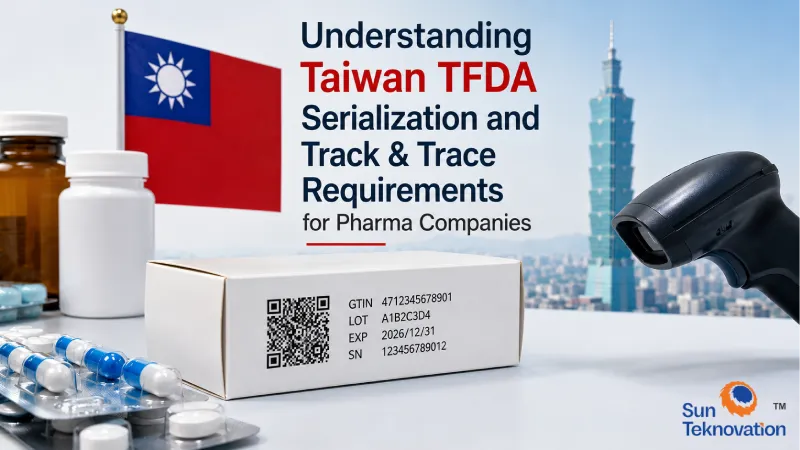
Key Takeaways
- Taiwan TFDA Serialization mandates that manufacturers create a traceability system based on product categories.
- Monthly tracking and tracing submissions are required for compliance in Taiwan, emphasizing consistent reporting discipline.
- Proper inline verification of printed codes ensures compliance and prevents costly distribution errors.
- Confirm specific marking requirements with the TFDA to ensure accurate product labeling for Taiwan TFDA Serialization.
- Companies must maintain traceability records for at least five years according to the Pharmaceutical Affairs Act.
If you manufacture or export medicines into Taiwan, traceability is a legal obligation rather than a commercial preference. Yet the same gap keeps appearing on lines across Asia: the serialization software is running, the reporting account is open, and nobody is verifying what the printer actually put on the pack.
What the Law Actually Says
Article 6-1 of the Pharmaceutical Affairs Act places the obligation on distributors and manufacturers of drugs in categories announced by the central competent health authority.
Those businesses must establish their own traceability system for tracing the source and tracking the flow of their products, according to their industry mode of operation. The authority operates the central reporting system, and covered businesses declare into it electronically.
Two consequences follow, and both matter commercially:
- The obligation is category-based, not blanket — your product classification decides whether you are covered
- The traceability system is yours to build — Taiwan defines what must be reported, not the platform you use to do it
Which Products Are Covered
Taiwan phased this in rather than switching everything on at once.
Plasma-derived medicinal products, vaccines and botulinum toxin were announced as the first three priority categories, effective from 1 July 2017. Risk profile, along with quality, efficacy and safety, drove that prioritisation.
Following the counterfeit Crestor incident, the TFDA added twenty medicines from the top national health insurance reimbursement items as a pilot category. Expansion since then has been coordinated with the implementation timetable for Good Distribution Practice.The covered list is a moving one. Confirm your product's current status with the TFDA rather than working from an older category list.
The Reporting Rhythm Exporters Overlook
Product licence holders, wholesalers and retailers must submit tracking and tracing information electronically before the 10th of every month.
A monthly cycle sounds comfortable until you consider what fits inside it. Production data reconciled, aggregation records checked submission prepared and validated — every month, without a gap, through shutdowns, holidays and changeovers.
Miss that window and you have a compliance problem no amount of printing accuracy repairs. A Track and Trace System in India built for Taiwan supply should be specified around repeatable reporting, not code printing alone.
Barcode Standards: Verify by Product Category
This is where published guidance frequently overstates the position, so it is worth being precise.Taiwan does not universally mandate GS1-128 across all pharmaceutical serialization.
Regulatory references describe a GS1-compliant 2D Data Matrix as the mark carried on secondary packaging for regulated products, while noting GS1-128 in use for many products, typically where linear symbology suits the label or the packaging level. In practice most manufacturers encode a Data Matrix at saleable-unit level and may use GS1-128 at case or pallet level.
Before artwork approval:
- Confirm the marking requirement for your specific product category with the TFDA or a qualified Taiwan regulatory affairs professional
- Check that human readable information on the pack matches the encoded data — a routine failure when the two are proofed separately
Where Most Packaging Lines Fall Short
The requirements are clear. The gap is in execution, and it sits at the point of print.
Most companies invest properly in serialization software, ERP integration and reporting tools, then underestimate the step that decides compliance on the floor: verifying the physical output before the pack is sealed.
A code that looks acceptable to the eye but grades below the machine-readable threshold is still a failure. Common failure points include:
- Codes printed with correct content but falling below scan-grade thresholds due to poor substrate contrast
- Expiry or batch text legible to a person yet grading below machine-readable standard
- Transposed date characters that survive a visual check and surface only during a recall
- Missing or partially printed codes on high-speed blister lines running without 100% inline verification
A serious Track and Trace in India deployment pairs serialization with inline inspection rather than treating them as separate projects handled by separate vendors.
Verify First, Then Aggregate
Inline variable data inspection means every unit checked at full line speed, not a sample pulled every twenty minutes.
A correctly implemented system confirms:
- Lot number and expiry match the batch record in your ERP or MES
- The 2D code grades above the minimum readable threshold
- No character is missing or transposed
- Every passing unit carries a timestamped inspection record
That last point is the audit trail inspectors ask to see, because it demonstrates process control rather than system ownership.Track and Trace Aggregation builds on that verified base. Once each unit's printed data is confirmed accurate, linking units into cartons, cases and pallets becomes dependable. If the base data is wrong, aggregation carries the error upward through the hierarchy — which is exactly why unit-level verification comes first.
Where the hierarchy has been properly commissioned, a recall investigation works from recorded relationships instead of reconstructed paperwork. Whether that data is also reported is a separate question, since aggregation reporting requirements differ by country and should be confirmed for your category.
Record Keeping
The Pharmaceutical Affairs Act sets retention obligations of at least five years for specified categories of records, and companies are separately expected to maintain complete distribution records for traceability, including at their distributors.
Retention periods vary by record type. Confirm which applies to your traceability data rather than adopting one figure across the board. What holds in every case is that records must be retrievable on request, in a form an inspector can work with.
Before You Commit to a Partner
Meeting TFDA requirements is part hardware, part software and part reporting discipline, and the partner you select decides how well the three hold together.
Questions worth putting to any supplier:
- Can the system verify every unit at our actual line speed, not a sample rate?
- How does it handle marking differences if our product category requirements change?
- What does the monthly submission workflow look like in practice?
- Does the audit trail format match what an inspector will ask us to present?
Capable Track and Trace System Manufacturers in India work into your existing line and existing Track and Trace in India setup rather than forcing a rebuild, so compliance runs as one connected process instead of a monthly scramble.
Why Choose Us
At Sun Teknovation Pvt Ltd., combines machine vision engineering with a working understanding of regulated pharmaceutical markets, and that combination shapes how our systems are built. We treat TFDA compliance as a question of proving that every printed code on every unit is accurate, readable and traceable, not simply installing software and closing the project. Our serialization and inline inspection systems run at genuine line speeds, integrate cleanly with existing infrastructure, and produce the timestamped audit trail inspectors expect. We work alongside your team through integration, validation and audit preparation, and stay available long after go-live. Where a requirement depends on your product category, we tell you to verify it rather than guessing on your behalf.
Conclusion
Taiwan rewards manufacturers who go past software and verify what their lines physically produce. Category-based coverage, monthly electronic reporting, correct marking for your classification and dependable record keeping all rest on one foundation — accurate, machine-readable data on every pack. Inline verification closes the gap that trips up most lines and turns a serialization investment into demonstrable compliance.
Getting ready for TFDA compliance in Taiwan? Talk to Sun Teknovation about serialization and inline inspection systems built for regulated markets. Call +91 98982 45695 or email connect@sunteknovation.com today.
Frequently Asked Questions

Ajay Roshania
Co-Founder & Director (Technical), Sun Teknovation Pvt. Ltd.
Visionary leader driving India’s pharma innovation globally. Expert in turning regulatory challenges into growth opportunities. Leads development of intelligent, future-ready systems that ensure compliance, trust, and scalability. Champion of “Made in India, Trusted Everywhere,” preparing the pharma industry for long-term success.