


Key Takeaways
- Pharma code readers verify product identity, while OCR ensures text accuracy on pharmaceutical packaging.
- Choosing between Pharma code reader vs OCR depends on the type of errors you need to detect.
- A unified inspection system can handle both Pharma code verification and OCR, streamlining compliance processes.
- Improper use of Pharma code readers and OCR can lead to significant compliance gaps in packaging lines.
- Pharma code readers verify product identity, but don't check batch details or text accuracy, unlike OCR systems.
Sun Teknovation Pvt Ltd is a Leading Provider of Machine Vision and Track & Trace Solutions for the Global Pharmaceutical Industry.
When you are setting up or upgrading an inspection station on a pharmaceutical packaging line, one question comes up more than almost any other — do we need OCR, or will a Pharma code reader do the job?
It sounds like a technical detail. In practice, it is a compliance decision. The wrong answer means your line is either under-inspecting — missing errors that reach the market — or over-specified in the wrong area while still missing the actual risk. This blog breaks down what each technology does, where each belongs, and how to make the right call for your specific packaging application.
What a Pharma code Reader Actually Does
Pharma code is a 1D barcode format used specifically in pharmaceutical packaging — typically printed on cartons, labels, or foil to identify the product type. A Pharma code Verification System reads this code and confirms that the product on the line matches the expected Pharma code for that batch or SKU.
This is a product identity check. It catches a very specific and important error — the wrong product or label on the wrong line. In blister packaging, foil printing, and cartooning operations, Pharma code verification is a standard line clearance and mix-up prevention tool.
What it does not do is read or verify the human-readable text printed alongside or separately on the pack. The batch number printed in ink, the expiry date stamped on the foil, the MRP or dosage text — none of that is captured by a Pharma code Verification System alone. It reads the code, confirms the identity, and stops there.
What OCR Inspection Actually Does
OCR Inspection Pharma Line technology takes a camera image of printed text and reads it character by character — then compares what it reads against what the batch record says should be there.
This is a text accuracy check. It is the right technology when the risk is not "wrong product on the line" but "correct product, wrong batch details printed." Overprinting errors — a wrong expiry date, a transposed batch number, a missing manufacturing date — are caught by OCR, not by Pharma code reading.
OCV (Optical Character Verification) takes this one step further — it does not just read the text but verifies that the print quality, font, and character formation meet defined standards. For high-speed lines where overprint degradation is a risk, OCV adds the layer that OCR alone cannot provide.Neither OCR nor OCV replaces Pharma code verification. They address a different failure mode entirely.
Pharma code Reader vs OCR — Which One Do You Need?
The question of which error your inspection is intended to detect is essentially what the Pharma code Reader vs. OCR debate is about:
| Application | Right Technology |
|---|---|
| Wrong label / product on wrong line | Pharma Code Verification System |
| Wrong batch number or expiry date printed | OCR Inspection Pharma Line |
| Poor print quality on overprinted text | OCV (Optical Character Verification) |
| 2D serialization code verification | 2D Barcode Reader (Data Matrix / QR) |
| All of the above on one line | Integrated multi-code vision system |
Most regulated pharmaceutical packaging lines — particularly those supplying export markets — need more than one of these capabilities active simultaneously. When a carton exits a secondary packing line, it must have its Pharma code validated, its overprinted batch details read and checked, and its 2D serialization code decoded and connected to the batch record. Three different inspection tasks, ideally handled in a single pass by one integrated Barcode Reader Pharmaceutical Packaging system.
Running separate stations for each adds complexity, increases line length requirements, and creates gaps between inspection zones where unverified packs can slip through.
Where Most Lines Get This Wrong
The most common mistakes we see when auditing packaging line inspection setups:
- Using Pharma code alone for text verification: The operator believes the pack is accurate since the Pharma code scans clean. The overprinted expiry date was wrong on every pack in the batch. The Pharma code reader never would have caught it because it was never designed to.
- Using OCR without Pharma code — Text verification is active, but there is no product identity check. A label mix-up at line setup goes undetected because OCR is only looking at character accuracy, not whether the right label is on the right product.
- Treating 2D barcode reading as a substitute for OCR — A 2D code scan confirms the serial number but does not verify the human-readable text printed separately on the pack. Both need to be checked. Vision Inspection OCR vs Barcode is not an either/or — in a compliant packaging environment, both serve distinct roles that do not overlap.
How eSanket Handles Both in One System
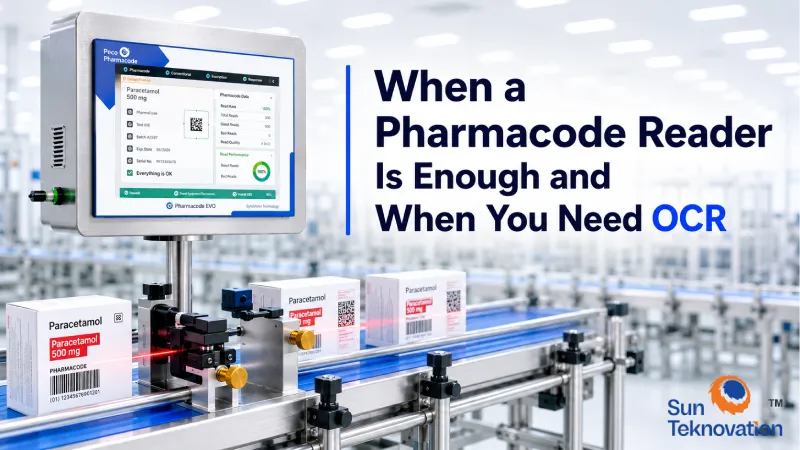
Sun Teknovation’s eSanket is built as a unified Barcode Reader Pharmaceutical Packaging platform — one system that handles Pharma code, 1D barcodes, 2D Data Matrix, QR codes, OCR, and OCV within a single inspection pass at up to 600 inspections per minute.
eSanket combines several cameras and adaptive illumination into a single inline unit, eliminating the need for separate stations for each form of inspection. This allows it to read all code types concurrently and produce a single certified result per pack. This satisfies the entire Vision Inspection OCR vs. Barcode requirement without requiring extra equipment, longer lines, or more operator interfaces to handle.
For foil code reading on primary packaging, carton inspection on secondary lines, and label verification across both — eSanket adapts to the application rather than requiring the line to adapt around it. Sun Teknovation Pvt Ltd supports integration with Labeling machines, cartoners, conveyors, and stick pack machines, with camera resolutions from VGA up to 5MP to match surface and code size requirements.
Why Choose Us
At Sun Teknovation Pvt Ltd., we do not sell inspection hardware and leave the application decision to the buyer. Our team evaluates your specific packaging line — product types, code formats, surface materials, line speed — and recommends the right combination of Pharma code verification, OCR Inspection Pharma Line capability, and barcode reading to cover your actual compliance risk. The eSanket platform reflects 14+ years of pharmaceutical packaging inspection experience, with 1,250+ installations globally and active deployments across markets with strict GMP inspection requirements. When you work with Sun Teknovation Pvt Ltd, the Pharma code Reader vs OCR question gets a specific answer for your line — not a generic one.
Conclusion
It doesn’t matter which technology is superior when choosing between an OCR Inspection Pharma Line and a Pharma code Verification System; what matters is which fault each is intended to detect.Pharmacode confirms product identity. OCR confirms text accuracy. Both address real failure modes that the other cannot detect. For most regulated pharma packaging lines, especially those supplying export markets with strict Barcode Reader Pharmaceutical Packaging requirements, running both within a single integrated system is the only way to cover the full inspection scope without gaps. Sun Teknovation Pvt Ltd.’s eSanket delivers exactly that — one system, every code type, one verified result per pack.
Not sure whether your line needs Pharma code verification, OCR, or both? Connect with Sun Teknovation Pvt Ltd today and get a clear answer based on your specific packaging application and compliance requirements.Call us: +91 98982 45695 or email connect@sunteknovation.com.
Frequently Asked Questions

Ajay Roshania
Co-Founder & Director (Technical), Sun Teknovation Pvt. Ltd.
Visionary leader driving India’s pharma innovation globally. Expert in turning regulatory challenges into growth opportunities. Leads development of intelligent, future-ready systems that ensure compliance, trust, and scalability. Champion of “Made in India, Trusted Everywhere,” preparing the pharma industry for long-term success.